Fast delivery within 24 hours
Integrated customer cloud for digital parts
Over 2,000 orchestral works in the catalogue
Personal advice — orch@bnote.de SOS +++ EMERGENCY PARTS SERVICE
Distribution for renowned partner publishers
Online tool for pre-print string annotations
Fast delivery within 24 hours
Integrated customer cloud for digital parts
Over 2,000 orchestral works in the catalogue
Personal advice — orch@bnote.de SOS +++ EMERGENCY PARTS SERVICE
Distribution for renowned partner publishers
Online tool for pre-print string annotations
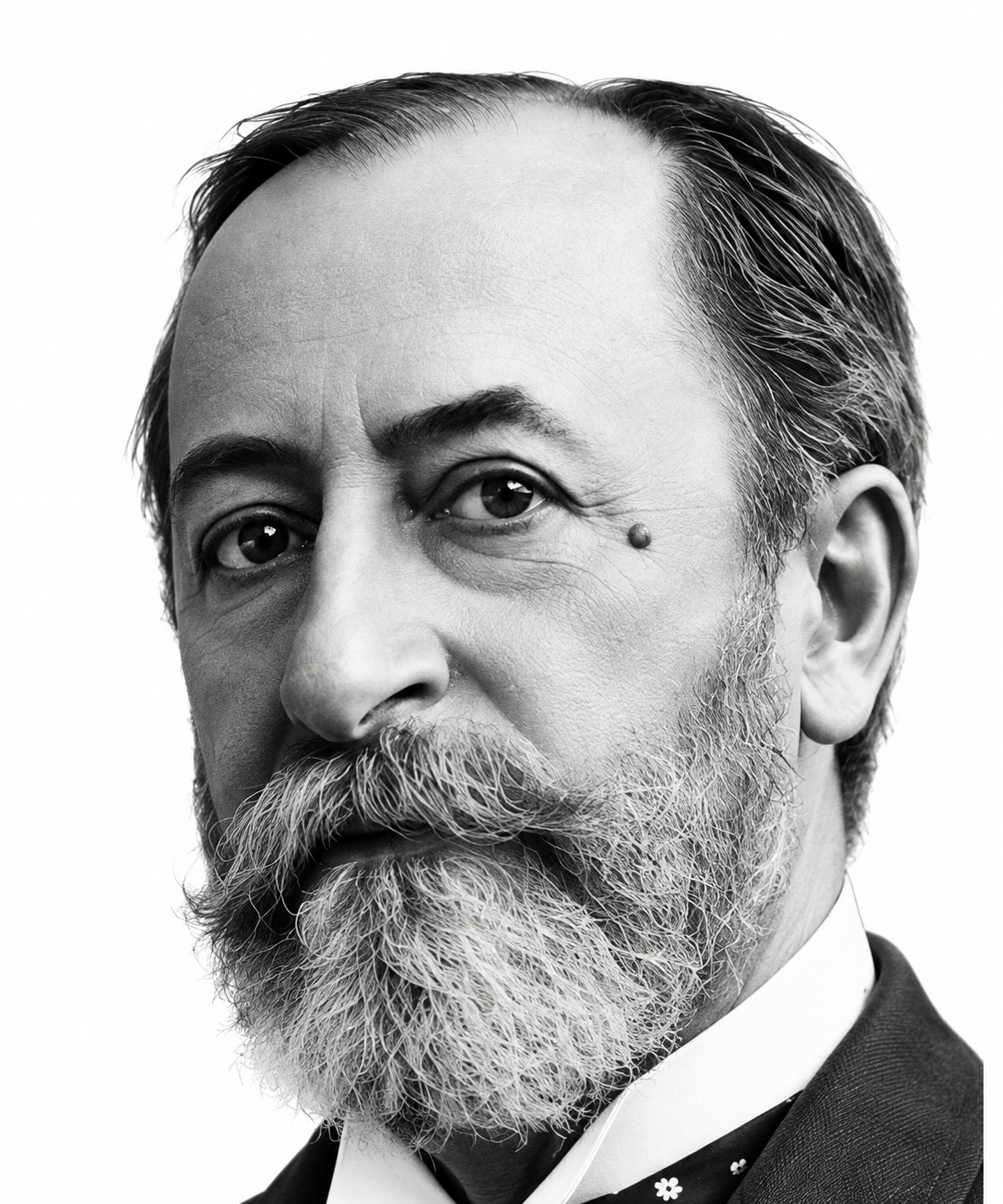
Short biography Camille Saint-Saëns was born on 9 October 1835 in Paris, France, and showed extraordinary musical gifts from earliest childhood, entering the Paris Conservatoire at the age of thirteen. He studied organ and composition there, going on to serve as organist at the Madeleine church in Paris from 1858 to 1877, a post that brought him wide recognition. A tireless traveler and prolific creator, he worked across virtually every genre of Western art music throughout a long career that spanned the reigns of several French governments. He died on 16 December 1921 in Algiers, Algeria, having remained active as a composer and pianist into his final years.
Historical placement Saint-Saëns belongs to the generation of French composers who bridged the late Romantic era and the early modern period, working in a style that prized formal clarity, craftsmanship, and a neoclassical sense of balance alongside Romantic harmonic richness. He was a central figure in the revival of French instrumental music in the second half of the nineteenth century, at a time when French concert life had been largely dominated by opera and by foreign symphonic repertoire. As a co-founder of the Société Nationale de Musique in 1871, he helped create an institutional platform for new French orchestral and chamber works, leaving a lasting mark on the infrastructure of French musical life.
Personal connections Franz Liszt, whom Saint-Saëns knew personally, was a prominent admirer who reportedly praised him as the greatest organist in the world. Gabriel Fauré was Saint-Saëns's most celebrated student, having studied with him at the École Niedermeyer in Paris. Hector Berlioz was a senior French contemporary with whom Saint-Saëns had documented professional contact and mutual regard. Charles-Marie Widor was a close colleague within Parisian organ and compositional circles, though the precise nature of their professional collaboration is not always detailed in sources.
Important works
Symphony No. 3 in C minor, "Organ Symphony" – Symphony (Op. 78, 1886)
Piano Concerto No. 2 in G minor – Concerto (Op. 22, 1868)
Violin Concerto No. 3 in B minor – Concerto (Op. 61, 1880)
Cello Concerto No. 1 in A minor – Concerto (Op. 33, 1872)
Samson et Dalila – Opera (Op. 47, 1877)
Danse macabre – Symphonic poem (Op. 40, 1874)
Le Carnaval des animaux – Suite for chamber ensemble (1886; published posthumously)
Introduction et Rondo capriccioso – Violin and orchestra (Op. 28, 1863)
Havanaise – Violin and orchestra (Op. 83, 1887)
Septet in E-flat major – Chamber music (Op. 65, 1881)
Here you will find further reprint editions from various sources which we are still preparing for inclusion in our main catalogue. As a rule they are already available. This archive also allows you to search for editions of the former Kalmus catalogue by reference. Almost all public-domain works from that catalogue can be supplied quickly, identical in content and quality. Please do ask!