Fast delivery within 24 hours
Integrated customer cloud for digital parts
Over 2,000 orchestral works in the catalogue
Personal advice — orch@bnote.de SOS +++ EMERGENCY PARTS SERVICE
Distribution for renowned partner publishers
Online tool for pre-print string annotations
Fast delivery within 24 hours
Integrated customer cloud for digital parts
Over 2,000 orchestral works in the catalogue
Personal advice — orch@bnote.de SOS +++ EMERGENCY PARTS SERVICE
Distribution for renowned partner publishers
Online tool for pre-print string annotations
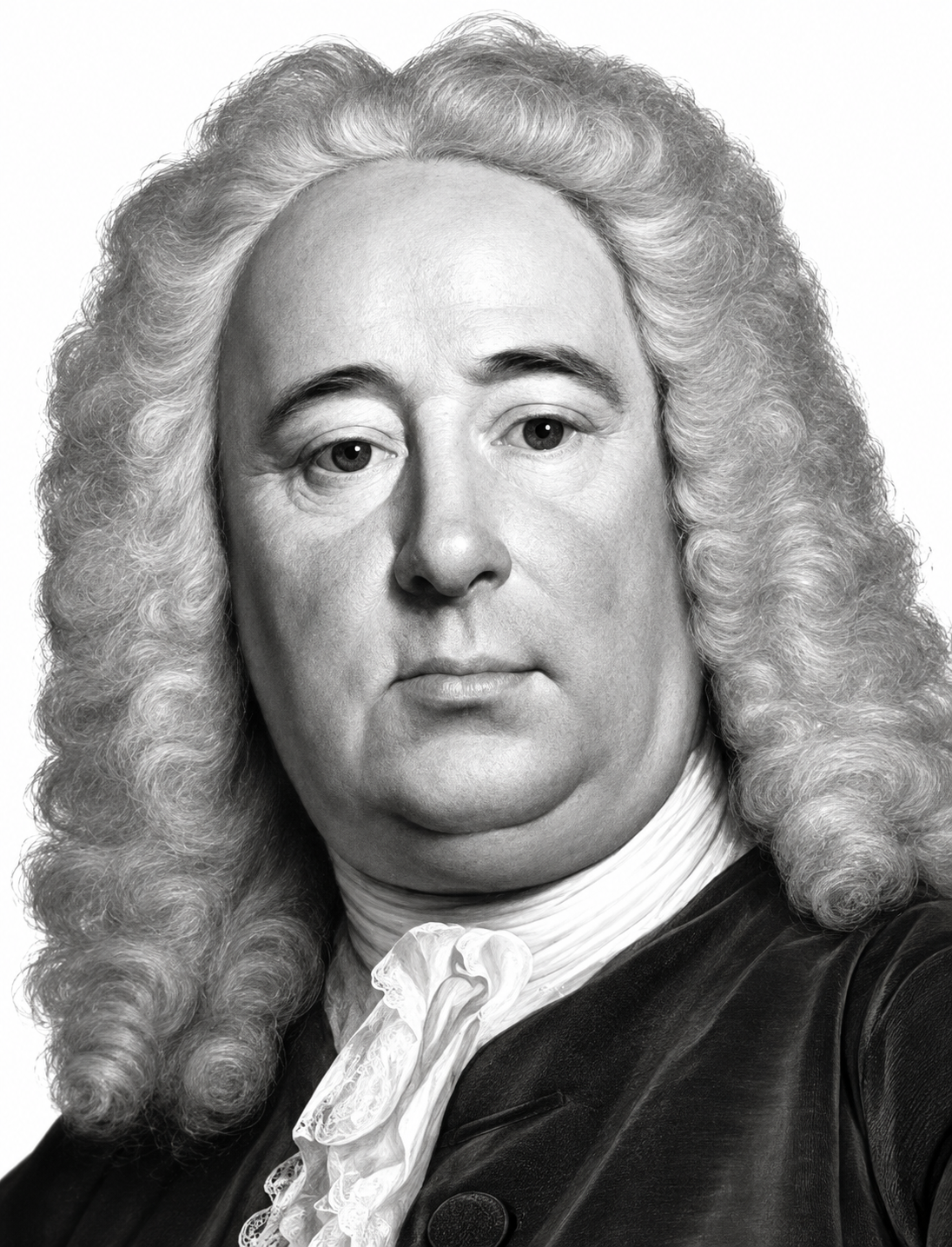
Short biography Georg Friedrich Handel was born on 23 February 1685 in Halle, in the Duchy of Magdeburg (then part of the Holy Roman Empire). He studied keyboard and composition under Friedrich Wilhelm Zachow in Halle before briefly enrolling at the University of Halle in 1702. He subsequently held a position at the Hamburg opera, then traveled to Italy (1706–1710), where he gained exposure to Italian operatic and vocal styles, before being appointed Kapellmeister to the Elector of Hanover in 1710. He settled permanently in London from around 1712, becoming a naturalized British subject in 1727 and remaining there until his death on 14 April 1759.
Historical placement Handel is a central figure of the Baroque era, active in the first half of the eighteenth century alongside contemporaries such as Johann Sebastian Bach. His work is characterized by grand melodic invention, mastery of counterpoint, and the blending of German, Italian, and English stylistic traditions. He is credited with establishing the English oratorio as a major genre and exerted a profound influence on later composers, including Haydn, who cited Handel as an inspiration for his own oratorios.
Personal connections Friedrich Wilhelm Zachow was Handel's principal teacher in Halle, providing his foundational training in counterpoint and keyboard. Arcangelo Corelli, whom Handel encountered in Rome during his Italian years, was a documented contemporary whose circle he moved in. John Christopher Smith (Johann Christoph Schmidt the younger) served as Handel's close assistant and copyist for many years, and later helped complete and adapt some of Handel's works.
Important works
Messiah – Oratorio (HWV 56, 1741)
Rinaldo – Opera (HWV 7, 1711)
Water Music – Orchestral suite (HWV 348–350, 1717)
Music for the Royal Fireworks – Orchestral suite (HWV 351, 1749)
Giulio Cesare in Egitto – Opera (HWV 17, 1724)
Israel in Egypt – Oratorio (HWV 54, 1739)
Saul – Oratorio (HWV 53, 1739)
Samson – Oratorio (HWV 57, 1743)
Twelve Grand Concertos – Concerti grossi (Op. 6 / HWV 319–330, 1739)
Organ Concertos – Concerti (Op. 4 / HWV 289–294, 1738)
Here you will find further reprint editions from various sources which we are still preparing for inclusion in our main catalogue. As a rule they are already available. This archive also allows you to search for editions of the former Kalmus catalogue by reference. Almost all public-domain works from that catalogue can be supplied quickly, identical in content and quality. Please do ask!